
Help and Support » Calculations
HRV
Heart rate variability
Heart rate variability (HRV) is the physiological phenomenon of variation in the time interval between heartbeats and is measured by the variation in the beat-to-beat interval. It is well known that HRV is directly related to the body's interdependent regulatory systems and can be a powerful measure for an athlete's recovery status.
HRV during exercise
It is best practice to measure you heart rate variability on a daily basis e.g. each morning after waking up while still in bed. Unfortunately, that's not what is contained in all that data you upload to Runalyze. Instead, you go out for a run or a ride and measure your heart rate (and its variability) during exercise.
HRV analysis can be done for HRV during exercise as well but values are less reliable and vary alot between different intensities.
Please be cautious while interpreting your values.
HRV in Runalyze
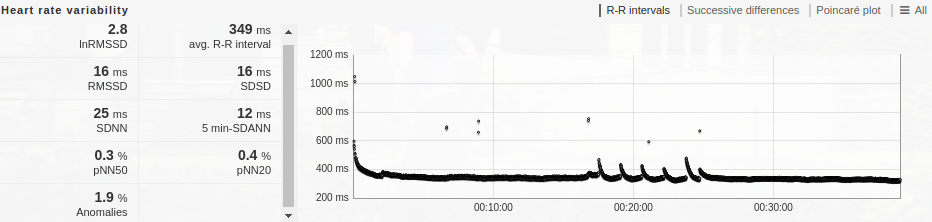 Runalyze offers HRV analysis for all files that contain exact R-R intervals, i.e. the exact times between all heartbeats.
This can be the case for *.fit files from Garmin (if respectively configured), *.hrm files from Polar (1) and *.xml, *.sml files from Suunto.
Runalyze offers HRV analysis for all files that contain exact R-R intervals, i.e. the exact times between all heartbeats.
This can be the case for *.fit files from Garmin (if respectively configured), *.hrm files from Polar (1) and *.xml, *.sml files from Suunto.
Most devices using an optical sensor for measuring heart rate are not accurate enough (e.g. Mio Alpha, see Bad devices, but there are ways to achieve good accuracy with opical measurements, see Camera HRV.
Time-domain methods
Runalyze uses the following time-domain methods:
avg. R-R interval
average R-R interval, directly related to average heart rate
RMSSD
root mean square of successive differences
lnRMSSD
natural logarithm of RMSSD
SDNN
standard deviation of R-R intervals
5 min-SDANN
standard deviation of the average R-R intervals calculated over 5 minutes
pNN50
proportion of successive R-R intervals that differ by more than 50 ms
pNN20
proportion of successive R-R intervals that differ by more than 20 ms
Especially RMSSD (and its equivalent lnRMSSD) and pNN50 are said to be strong indicators for parasympathetic activity (3) and thus large values indicate a better recovery status.
From v2.6 on, RUNALYZE does use only R-R intervals that differ from the preceding or following interval by less than 75 % (as suggested in ediss1118 (2.4.2.1)).
Further readings
A look at a few months of hrv data
Marco Altini, a data scientist and creator of multiple hrv based apps, measured his hrv every morning for a few months and presents the results on his blog.
Heart rate variability explained
Andrew Flatt, who did a lot of research on HRV, explains HRV.
References
Related articles
Didn't find an answer to your question?
Please let us know if you have wishes or have encountered bugs. We give our best to make Runalyze as good as possible for you. - Therefore we would be interested in your suggestions for improvement. In general most questions, problems and ideas are more appropriate to ask in the forum.
 Follow us